Pages

Thursday, August 11, 2016

Make Way for Ducklings

 For our second week of school, we spent the week with Make Way for Ducklings by Robert McCloskey, which is in Volume 2 of the Five in a Row curriculum.

Our family has been dreaming of buying a little mini-farm in the country. We've spent the last six months renovating our house and decluttering and trying to sell our house. I even convinced the kids to sell some of their excess toys at a tag sale and start saving for their livestock fund.

For now our dream  of moving seems to be on hold, but the kids still love to imagine all the livestock they can have in our dream house. After their dad played them a homesteading podcast about keeping ducks, ducks replaced sheep on their list. So they were eager to learn more about ducks.
 
I am still learning lessons in these first few weeks of homeschool. Every year, I print out way too many printables at the beginning of the year. My kids actually love worksheets. In fact, they will beg me to print out worksheets for them just for fun. However, I often fall into the trap of thinking, "if I print out that mini-book about animal parenting, that will help us learn about ducks," when really what it turns into is "we will have something to put into our binder to show we learned something." Well, this week reminded me how real learning happens:: by interacting with nature, reading great books, and integrating knowledge into play.  

We started out our week with a lesson in geography. I found a map of Boston and we traced the route Mr. and Mrs. Mallard too from the Boston Public Gardens to the island in the Charles River and back. McCloskey was an art student in Boston, so all of the pictures are based on real places he would walk by on his way to art school. We are planning a field trip to the Boston Public Gardens to ride the swan boats soon.

On our second day we read several non-fiction books about ducks and nests and played a mother and baby animal matching game with my younger two. I knew I had printed this out last year and searched my whole house, then as soon as I pulled the cards out, my daughter goes to the cabinet and pulled out the old laminated cards. Now we have two sets! I did print out the cards 2 pages to a sheet the second time, which made them the size of regular Memory cards.  I had planned to do a mini-lapbook page, but after the kids declared they were going to gather up all their toy ducks and play duck farmers, I left them to it and recycled the pages. 

My oldest daughter remembered that she had seen ducklings at a local petting farm when she was on a Daddy-date, so we decided we would go there and draw and observe ducks the next day. She even printed us up some official nametags and laminated them so it would be an official field trip.
The ducklings had grown up some, but there were lots of mallards to observe. Gary Schmidt has some wonderful stories about the making of Make Way for Ducklings in his biography Robert McCloskey. Did you know that Robert McCloskey spent over two years on the art for Make Way for Ducklings? He studied stuffed ducks at the Museum of Natural History. He visited an ornithologist to learn about the shapes of their skulls. Eventually, he decided to buy live ducklings for his models. He carried them home on the subway and kept them in his studio in New York. His roommate Marc Simont drew the bad lot of having to share a bedroom with the ducklings. The little ducklings caused quite a ruckus in the studio. Gary D. Schmidt quoted McCloskey as saying "I spent the next weeks on my hands and knees, armed with a box of Kleenex and a sketch book, following ducks around the studio and observing them in the bath tub." They sloshed water from the tub, leading to complains from the apartment downstairs." The ducklings were always too fast for McCloskey, so"The solution for their rapid movement was an unorthodox one. "The only thing that worked was red wine. They loved it and went into slow motion right away." When he was done, McCloskey wandered all over New York trying to give the ducks away to a butcher and came home defeated with a box of loud, hungry ducks.  They eventually were taken in by a friend in the country.

My nine-year-old took her camera along and took some amazing portraits of the ducks. 

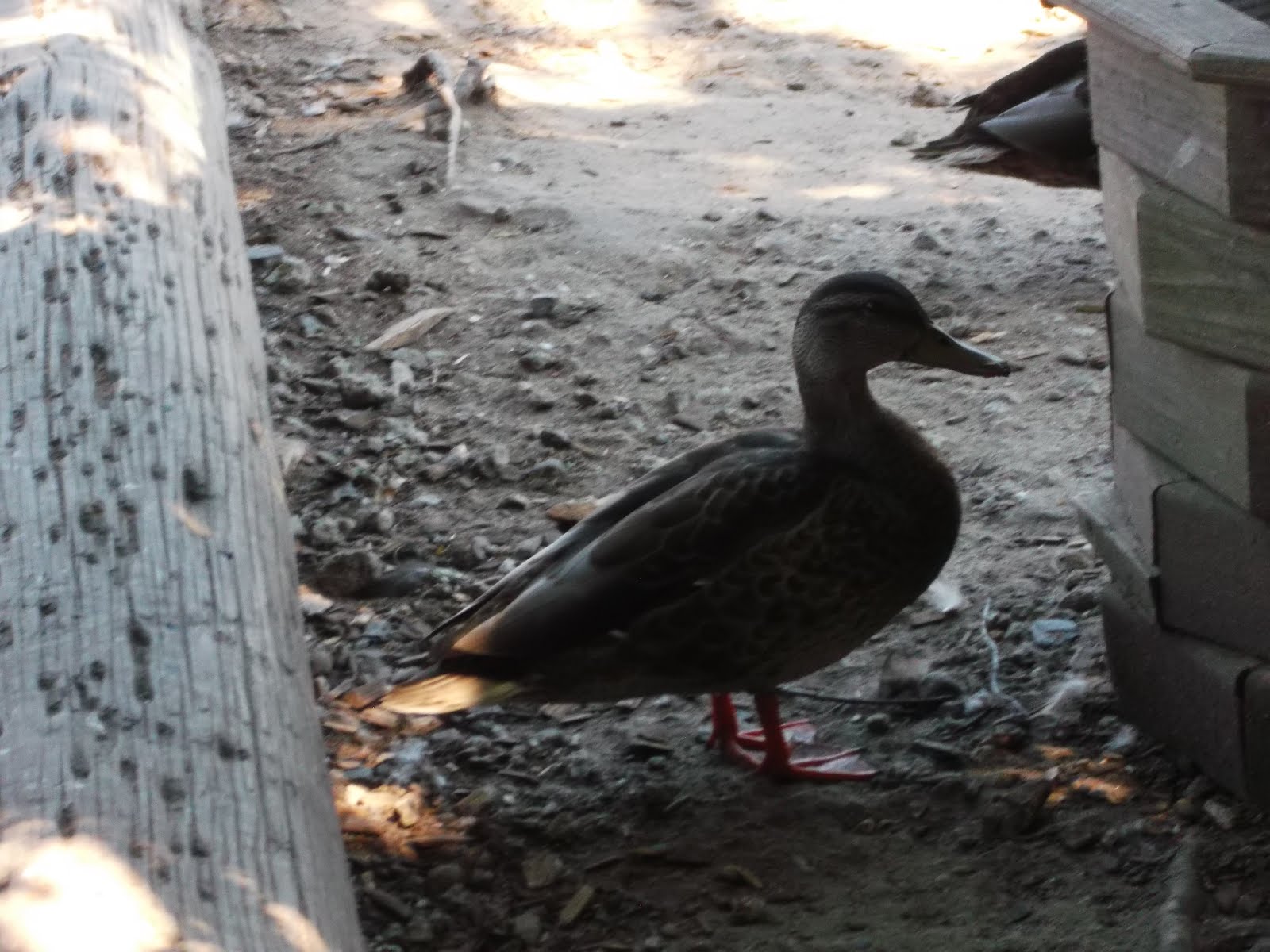
They were also made great models for some scientific drawings and notations such as differences in duck bills in different breeds of ducks.
We also got to practice drawing from live models.
My four-year-old was not interested in drawing, but he did love finding out if the ducks like peanuts. They do! When a mower disturbed some mallards resting in the shade, two dozen ducks jumped into the water and swam across. He shouted, "It's the real Make Way for Ducklings!" 

Of course, we had to visit the pigs, llamas, mini-donkeys, goats, chickens, and peacocks at the farm too, and go home with a half-gallon of mint-cookie ice cream. A great field trip, all told.

On Thursday, we learned about rhyming words and made a word family of ducks in a pond. I printed out some duck outlines using the clipart on Microsoft word and the kids filled them in with words that rhymed with -ack or -uck. We managed not to get into any trouble with that one. We also learned the spelling rule for words ending with -ck. I'm trying to stick spelling rules in wherever we can these days! We had our weekly poetry tea time with ice tea and ice cream from the day before.

Then on Friday, we watched an excellent National Geographic film we found at the library called "Duckumentary."

When I write about our "rows" with Five in a Row, I never feel like I get to the heart of it all, because really "heart" is what is at the core of this curriculum. The books were carefully chosen for their heart, and the Five in a Row manuals have taught me how to read books with my kids in a way that is about relationships as much as learning.  The little conversations you have with your kids about how a parent makes a good home for a child (even if they are ducks) or noticing little details in the drawings like the expression on Mrs. Mallard's face when she is leading the ducklings down the street, or the way your kid will pop up with some little bit of information days later about mallard ducks or nests or art, those are the priceless parts of our weeks that I can't quite capture here.

Saturday, August 6, 2016

Why We Need Robert McCloskey's Books in a World at War


While I am sure that I probably read Robert McCloskey's classic books like Make Way for Ducklings and Blueberries for Sal when I was a child, I didn't really discover Robert McCloskey until my mom recommended his book One Morning in Maine when I was a new mother. I found a beautiful copy at a thrift store on vacation, and fell in love with the book. I have only visited Maine a few times on vacation, but there was something warm and friendly and rooted in place about the book that drew me in. It's a long book by today's standards: 63 pages to the typical 32 and, yet, I could read it over and over again because of all the unique details about life in Maine: the loons and seagulls, and little Sal losing her tooth while digging for clams with her father. Then there is the adventure of Sal and her little sister Jane going on the boat with their Dad to Buck's Harbor and telling the exciting news of the lost tooth to all the town regulars, getting a free ice cream cone, and being excited about having clam chowder for lunch. There was a simple joy that exuded from the pages.

Later I found out that McCloskey based the book on his own life. After returning from World War II, he bought an island in Maine where his family lived six months of the year. The daughters in the book are based on his real daughters, Sarah and Jane, and his wife posed for the drawings in Blueberries for Sal and One Morning in Maine. You also might recognize this guy...


I recently read a biography of Robert McCloskey by Gary D. Schmidt (yes, the same Gary D. Schmidt that is the Newbury-award-winning author of The Wednesday Wars). In his conclusion to the book, Schmidt really captured why McCloskey's books were so popular and needed when they came out in the mid-Twentieth-century, but also why we need them now...
 "McCloskey's vision of children's literature is the more remarkable considering that the two decades of his career in children's literature spanned the most turbulent time of the twentieth century...In the midst of this dreadful world--in the midst of folly and violence and threatened destruction--appeared a series of books that celebrated childhood, family, friendship, the natural world--in short, life itself. If this seems an anomaly, it might be noted that McCloskey's vision in his children's books is one of absolute affirmation of the permanence and beauty and significance of the world. "You snap off the light and row toward the dock as the stars are gazing down, their reflections gazing up, " he writes in Time of Wonder. "In the quiet of the night one hundred pairs of eyes are watching you, while one pair of eyes is watching over all."(28). The numinous quality of this affirmation denies the despair that might be caused by a world at war.
...The worlds of the Midwest, Boston, and the Maine coast are benevolent, full of wonder, physically splendid. They are homes with all that that word connotes; warmth and security, family relationships, innocent joys, the freedom for children to grow and relish the unalloyed splendors and mysteries of the world that lives close about them. McCloskey's strength was his ability to deny the primacy of a world that chose to war with itself. "Yes, that's true," he might say, "but come see this. It is ever so much more important." And the reader is drawn from sadness to joy, from despair to hope, from denial to affirmation."
 In a world wracked by violence, terrorism, and fear-mongering politicians, what can we as parents do to maintain hope and pass it along to our children? S. D. Smith, the author of The Green Ember, had an excellent article at BreakPoint.org called "Stories are Light: Ranting is Arson." I recommend reading the entire article, but to give you a taste, he advised. "By the time the election comes, it’s too late. It’s been too late for a long time. Our hearts were already won over by the stories we loved as children, the tales that shaped us as profoundly as anything else in life. Likely more." and "What is one thing you can do today to “save the world?” Read your children a good story. It may seem unsatisfying when compared with gearing up to blast the internet in a fever of pyromaniacal rage. But it will do a lot more good."


Robert McCloskey's books are a wonderful place to start. Pick blueberries with Sal, get an ice cream cone in Buck's Harbor with little Jane, learn to play a harmonica with Lentil, find a home in the Boston Public Gardens with Mr. and Mrs. Mallard, and make way too many donuts with Homer Price. In a time that feels cold and hopeless, we need books that help us dwell in a world of "warmth and security, family relationships, innocent joys, the freedom for children to grow and relish the unalloyed splendors and mysteries of the world that lives close about them."

 
If you like this post, you may also enjoy more Robert McCloskey goodness here: Why Our Children Need Art (and Picture Books)

Thursday, August 4, 2016

Our First Weeks: An Honest Retelling


Remember last year when I featured an "honest retelling" of our first week of school? Yeah, I'm back. Because it seems first weeks of school never go as you plan.
 
First a look back at our summer. We had been off of school since the end of May. We put our house on the market in June and spent our entire time off cleaning our house and trying to convince four children that they should not do anything that might make it seem like we actually live in our house. Then we went on an epic road trip. We got back, and the kids said, "Let's start school." So I was like, "Well at least it would keep them occupied," and "Since we're in the middle of a ridiculous heat wave, we might as well be inside in the A/C getting ahead on our school year."

Of course, I hadn't ordered any books or anything yet, so I quickly placed an order with Rainbow Resources. In the meantime, we still had a few things we were finishing up from last year, and I had all my Five in a Row books. Then lo and behold, I remembered that The Eric Carle Museum of Picture Book Art was hosting an exhibition of Robert McCloskey' art that I was dying to see.This seemed like a perfect case of Serendipity Homeschool, which is my preferred method of planning.
 
McCloskey is my favorite illustrator and four of his books are featured in the Five in a Row curriculum: Blueberries for Sal, Lentil, Make Way for Ducklings, and his chapter book, Homer Price. Since I was hoping to transition my older daughter into the Beyond Five in a Row curriculum this year, I thought why not jump in with doing three books at ONE time!! We had just picked blueberries so we could review Blueberries for Sal for my pre-k and kindergartener, Lentil for everyone together, and Homer Price for my older daughter. 

We started out with a lot of energy. My new kindergartener and my preschooler loved using real blueberries for math. They loved stamping with our blue stamper paints and making little books about Little Bear.We all attempted to make a model of the city of Alto, Ohio out of blocks. By that I mean, that we all played with blocks, but it was something.


Then we went on our first field trip of the year to The Eric Carle Museum of Picture Book Art to see the Americana on Parade: The Art of Robert McCloskey exhibit. Look we were happy!


This exhibit is one of the best I've seen at the Carle. In fact, I was very close to squealing when I saw that they had Robert McCloskey's own harmonica--just like in Lentil!!  I think you have to be a Five in a Row mom to get that excited about a harmonica.
 
We enjoyed seeing drawings from all of his books. My four-year-old was particularly enthusiastic about seeing Blueberries for Sal and Make Way for Ducklings.  He wanted to stop and read the books right there, even though the art was on the wall. Silly boy. My oldest daughter pointed out a sketch from Lentil and noticed, "That's not in the book at all. That tree was never in the book." As we looked closer, we saw that several of the Lentil drawings had never made it into the book. It was so interesting to see his process and what made it into the final copies. The museum even featured a full-color painting of Blueberries for Sal side by side with the blueberry-blue and white art from the book.  I actually prefer the illustrations from the book. As an added bonus to our trip, the museum happened to be having a visiting live animal show from a museum in Connecticut, so we got our science in by meeting some iguanas, turtles, toads, and snakes. All on our free pass from the library, not bad! We ended the day by making blue collages in the amazing art room at the Carle.

 
Then our first week of school (or maybe it was the second) began to get a little crazy. It's all a little muddled, in fact, as to what we actually did. I do remember trying to build a radio from scratch from a  kit for Homer Price, and wrapping this little copper wire around a toilet paper tube, and knowing that if the wires overlapped or crossed at all, the radio WOULD NOT WORK. As I was wrapping the wires (because of course, that part required help from an adult) one of the girls said, "I want to just go up to my room and cry." And another one saying, "Well, maybe we could find a radio that's already built." And I said, "But that would just be a radio. We have one of those. " And I wanted to go up to my room and cry.

Note to Self: You are not capable of building radios from scratch. Ask an engineer friend to help.

We did listen to some episodes of old-time radio for Homer Price, which the kids really enjoyed. They thought that Father Knows Best: The Skunk Must Go was hilarious.

Then there were the Thursdays, the ones marked on my plans after-the-fact as No School. On the first Thursday, I got a text from my husband who was in New York City for work asking if we could do a showing at 4:30. It was 10 am at the time. We hadn't cleaned our house since vacation. After a failed attempt at inspiring the children to help, I sat them down in front of the television all day, while I cleaned the house from top to bottom and did, in fact, at one point go up to my room and cry. Then around 3:45, my daughter who had been complaining that her stomach was hurting all day, threw up on the rug in the front hall. I can't tell you how we got out of the house by 4:30 with all the kids and our cat and our dog, but I think the sick five-year-old changed her own clothes and the carpet was still a little squishy. As a reward, we got to sat in our car for an hour and play ipads. Then, you won't believe this, but the next Thursday, the exact thing happened again, except that the kids were at their grandparents, and it was my son who was throwing up.

Yet by Friday, we had somehow pulled it together to have our first Poetry Tea Time of the year. We decided to make fresh-squeezed lemonade in honor of Lentil. We all had to taste the lemon first and make our best pucker in honor of Old Sneep. We also made homemade blueberry muffins from the last of the blueberries we had picked.
  
We read a portion of Robert Frost's poem "Blueberries" and chose from a selection of our books of American poems and nursery rhymes. We ended our week with a free showing of the movie Cars at the library and an awesome wearable car craft, that tied in nicely with the first chapter of Homer Price. Also there was free popcorn.
 
 Cheers to the end of July! Cheers to taking our house off the market! Cheers to surviving the first week of school! 
 
Also, later my nine-year-old sat me down, and said, "Mom, you know it's really too confusing doing so many books and projects all at once. Maybe we should just stick to one book at a time." So Make Way for Ducklings is getting a week all to itself.


Monday, August 1, 2016

You are Not in a Rush

 
The approach of a new school year often brings on an existential crisis for me. You know the one that goes: Am I doing enough for my kids? Will their chances of getting into a good college be ruined because we can't find a spelling curriculum that works? Will my child never find her genius if we don't take piano lessons in third grade? Should I have my child in gymnastics/ choir/ soccer/ archery/ piano/ that cool survival skills class?

Last year all these questions were hitting me pretty hard. We have always prioritized unstructured play and a slower-paced sort of life, but as our kids got older, there was more pressure to "enrich" their lives through extracurricular activities. We were also at the beginning of embracing an ultra-frugal season of our life so we could save money for some needed house repairs and get our financial life under control. All of these enrichment activities had a pretty high price-tag involved. Yes, the fees may not seem that high per child, but multiply that by four, it can add up. The other more hidden cost was that doing an activity for one child often meant that the rest of the family would have to wait in the car or find someway to occupy ourselves during practices.

As I worried over all of this, I felt like God whispered in my ear. "You are not in a rush."

What was I rushing towards, after all? Was I rushing through the years of picture books so we could get to chapter books? Was I rushing through my children's childhood so I could get to the next thing? So they could go to college? So I could have an empty nest? So that I could someday die?

In her poem, The Summer Day, Mary Oliver captured what I really wanted from my life: 
The Summer Day
Who made the world?
Who made the swan, and the black bear?
Who made the grasshopper?
This grasshopper, I mean-
the one who has flung herself out of the grass,
the one who is eating sugar out of my hand,
who is moving her jaws back and forth instead of up and down-
who is gazing around with her enormous and complicated eyes.
Now she lifts her pale forearms and thoroughly washes her face.
Now she snaps her wings open, and floats away.
I don't know exactly what a prayer is.
I do know how to pay attention, how to fall down
into the grass, how to kneel down in the grass,
how to be idle and blessed, how to stroll through the fields,
which is what I have been doing all day.
Tell me, what else should I have done?
Doesn't everything die at last, and too soon?
Tell me, what is it you plan to do
with your one wild and precious life?
—Mary Oliver

I thought about my grandmother's generation and how they raised large families in rural Appalachia during the depression. They had many worries I'm sure, but I think it's safe to say that they never stayed up at night worrying if they should sign up their kindergartener for tumbling class. I have talked to my aunts and uncles and cousins and what they remember from their hard-scrabble, hard-working, "unenriched" childhoods is joy. My mother made dolls out of overgrown cucumbers in the garden. They played games together and sat on the porch and snapped beans.  My cousin said that when they got bored or depressed in winter as kids, their mom would open a jar of blackberries they had picked and canned the summer before and make cobbler. They lived in a place of natural beauty. They had no technology, and so they made up their own fun. They grew foods, preserved them, and made them into pies.
When I compared that to the hectic schedule of most modern families, it was striking. In my mother's almost thirty years of teaching kindergarten and first grade in the public schools, she saw days added to the school week, recesses taken away, rest time taken away, and creative, playful learning exchanged for prescribed hours of tests and assessments. She saw even the youngest kids in school grow anxious and depressed.

 In Susan Schaeffer Macaulay's book For the Children's Sake, she wrote, ""Six-year-old children are as pressurized as executives. Children are being "fitted into" a streamlined schedule designed for parents so they can cope with their pressures. ...and so overentertained, pushed, pulled, and tidied up, often the child of today has the rich creative play response crushed out. Sometimes the only thing his dulled eyes focus on is a premature adolescence which will release him from childhood....Grown-ups need time if their life is to support this kind of play. ... This means saying no to too many time-consuming activities for both adults and children."

So we made the what-feels-like very counter-cultural choice to not sign up for any paid extracurricular classes, lessons, or sports last year. Instead I thought about what our kids really needed from time out of the house. It wasn't to learn a new skill or play on a team. We just needed time to play with friends.
 
So with our schedule opened up, I vowed to prioritize time with friends. I invited friends to meet up with us at the park. In turn, they invited us on adventures. We waded in creeks, swung on vines, went sledding. We carved pumpkins, decorated cookies,  exchanged valentines, and celebrated advent and lent with other families. We had dinner weekly with friends from church and talked about our lives and faith. I spent very little money on extracurricular activities, and yet, we got to see live owls and dissect owl pellets, and go on field trips to a planetarium, a fire station, and the fish ladders. We dressed up and had an Anne of Green Gables tea party. We dipped beeswax candles and made homemade pretzels with friends. My daughter didn't get to participate in choir, but we taught our kids and their friends all of our favorite old hymns and carols and they sang them at the top of their lungs.We all made dear, dear friends that we love to spend time with.

This year has taught me how to let go of  busy and the fear of missing out. Instead we have learned to be "idle and blessed."  Not over-scheduling our days gave us the freedom to say yes to unexpected invitations. Not rushing to the next activity or event gave us time to stay a little longer at the park, to pick apples and make applesauce from scratch, to savor each moment of this "one wild and precious life."

Tuesday, November 3, 2015

Mondays, Julia Child, and a Lesson in Joy

Untitled
Monday was a very Monday-ish sort of day. Exhausted from an intense weekend, I woke up, and realized that I had failed to plan anything for my homeschooling week. Most of the morning was eaten up by catching up on chores while my daughter pestered me to kick off her  first baking class by making a pear custard tarte out of Mastering the Art of French Cooking. We finally settled on reading a picture book set in France. Then it was lunch time, and there was nothing to eat for lunch.

That is how we ended up eating fish sticks in front of the television,while watching The French Chef with Julia Child, instead of making a pear and custard tart. Let's call it research.

I love watching these older episodes of Julia Child, the ones shot live while she was literally making up a cooking show as she went along. While discussing the baking qualities of various types of apples, she knocks over a canister of utensils. She fumbles with her mixer, drops pieces of aluminum foil on the floor, and forgets what she was going to say.

It is so much like the day-to-day life of a homeschooler. I work so hard to find the perfect recipe, then spend my days knocking over glasses of paint water, and fumbling with failed science experiments. I, too, am literally making it all up in front of a live audience, and sometimes (often) it flops.

My first few years of homeschooling were one long course in getting over my own perfectionism. In my head were these beautiful Martha-Stewart perfect photo montages of what if meant to be a homeschooler. While Martha's houses are endlessly creative, beautiful, (and full of busy staff), my house is flour on the counters, spotted apples that we pick for free, and watching The French Chef over lunch.

I put up these pictures on my blog of everything that went well, while behind the scenes,  the discussions in our house are more like this, "You won't believe how funny it was, when Mom slipped in her sock feet last night, and slid across the bathroom, trying to get the trash can to me so I could throw up in it." It is days floating rafts on rivers, and sobbing messes in the library; old-fashioned family projects and another lecture on how to be a civilized human being, again. It's homemade bread that comes out perfectly, and my daughter's enthusiasm over the splatter shield Julia attaches to her stand mixer, "That's just what we need so the powdered sugar doesn't fly everywhere when we make frosting!"

That is why I want to learn to live more like Julia Child. When the moment comes to finally unmold her tarte tatin from the skillet, it plops out, apples sliding one way and crust the other. She declares, "Well that unmolded...really rather badly." Instead of being upset by her mistake or feeling like a failure, she says that this is perfect because it gives her the opportunity to show us that "If everything doesn't happen exactly the way you like, you can always fix it" and "This is the kind of thing you have to expect even if you have guests peering at you in the kitchen, because you'll be able to fix it up with some powdered sugar." She sprinkles some powdered sugar on it, puts it under the broiler, and declares it "perfectly alright."

The really interesting part is when she takes out a tarte she had made earlier, that had baked up and unmolded from the pan just right. Instead of leaving her first sloppy pie in the kitchen, and carrying the perfect pie to the table. She grabs a platter in each hand and carries them into the dining room. "Now everybody can get one of each tarte, one of the juicy and one of the more tatin." With a dollop of creme fraiche, she announces that "That actually makes a more interesting dessert."

The reason we love Julia is not because she is perfect. Though I have to say she has one of the best recipes for pie crust out there. We love her because she taught us that cooking is not about perfectionism, but about joy and learning from our mistakes.

I think that is true of homeschooling too. I hope that when my best-laid plans end up in a sloppy mess, I will have the grace to scoop it up, sprinkle it with some powdered sugar, and present it as proudly as I do my perfect projects. Together they really do make a much more interesting dessert.

Monday, October 5, 2015

Dad-schooling: Foraging

 IMG_1761
For the last month or so, our family has been embracing frugality. We have been trying to cut our food budget, while still feeding our kids local, organic foods. Fortunately, we made this decision in Fall, right at the beginning of our CSA farm share, so we have been busy picking and freezing green beans, peppers, and ground cherries. Brent has also been canning beets, salsa, tomato sauce, pickles, and so much apple sauce. The most surprising thing we've discovered in this journey is that there is a wealth of free food out there in the world, once you start looking. A local museum that is built on an old orchard, invited its guests to come pick apples, so we did. They have a few spots, but they are beautiful, tasty apples, that were just falling on the ground otherwise. They are turning into applesauce, dehydrated apples, apple crisps, and apple muffins. Brent has turned the kids into expert foragers, always with an eye to abandoned fruit.

On labor day, our friend called us early in the morning with a special offer. Members of her family had just  purchased an old house and on the property was a well-established grape vine, which was loaded with ripe grapes. Did we want to come and pick them and do something with them? Yes we did. We threw on some clothes, loaded in our car, and set out.What did we find?
Untitled
 An arbor loaded with Concord grapes
 Untitled
We set to picking. Soon we had three giant pails full.
 Untitled
When we got home, Brent scoured the Internet for ways to can grapes. He started out with grape jam, which required squeezing the grapes out of the skin. Kinda fun, kinda gross all in one. Then pureeing the skins and cooking it all down with lots of sugar until it made jam. After two batches of jam, one with pectin and one without, we still had pails of grapes. So then we made Grape Shrub, an old-fashioned 19th drink Brent learned to make at his Preserving the Harvest class at Old Sturbridge Village. It involves cooking fruit, sugar and vinegar together to make a concentrate, which you can then later add to water to make a drink. After the shrub, we still had grapes, so we made canned Concord Grape juice.
  Untitled 
It wasn't exactly how we planned to spend our day off. But we were all so proud that when it comes to free food, we are ready to spring into action. Our PB & J's are secure for the winter.

Sunday, October 4, 2015

Five in a Row: Warm as Wool


I bought this beautiful book, Warm as Wool by Scott Russell Sanders, last year as part of our Five in a Row curriculum, but for whatever reason, we never got around to "rowing" it. Well, as it turns out, the timing was perfect. The story is about a pioneering family in 1804 who travel to Ohio to try and start a farm. The mother brings with her a spinning wheel, loom, and a stocking full of money to buy sheep, and eventually, through many trials, is able to start her own herd of sheep and clothe her family in warm, wool clothing.

Old Sturbridge Village was hosting a Homeschool Day in mid-September. They offered a series of inexpensive, hour-long classes, and one was in Carding, Spinning, and Weaving. The teacher gave a talk and slide show about how clothing was made from wool in the 1800s and my older girls got to try their hand at carding and weaving on the looms in their educational center. She really did all my work for me this week. I love Serendipity Homeschooling.
20150916_105514
Carding wool with carding paddles while learning a fun alphabet game.
 
20150916_110222
Watching the big loom in action

20150916_111012
Trying out the seated looms with foot pedals. These were the girls' favorites
 
20150916_111519
Trying a smaller table loom.

 We even met a friendly sheep there who let us pet her.
 20150916_113610
 We extended learning with lessons on western expansion. We read a book about Sacagawea and Lewis and Clark, and did a math activity to see how many goods we could pack into our covered wagon. We learned facts about sheep and read the 23rd Psalm at our tea time.

When we got back from OSV, the girls were eager to do more with wool. Since I have been trying to learn to needle-felt for a few years, I introduced the girls to the craft. We used a Sheep Finger Puppet craft from Martha Stewart Crafts for Kids book as an inspiration. We wet-felted the white part around our finger. Then we needle-felted the faces. Needle Felting needles are extremely sharp and barbed, but I found a safe way to let the kids try it, by using a cookie cutter. We used an acorn shaped mini-cookie-cutter for the head, filled it with black roving and carefully poked it with the needles. I helped them shape the wool for the eyes. Then we needle-felted the face to the white wool. We also had to make some needle-felted hedgehogs by the kids' request.  For these we used a large egg-shaped cookie cutter like below, and kept the wool we were shaping inside the cookie cutter and our other fingers on the outside to protect from pokes. Overall, it was a success, and we hope to try some more cookie-cutter felting for Christmas ornaments in the future.
  Untitled