Pages

Saturday, November 5, 2016

Five in a Row: Pumpkin Runner

October is always a crazy month for our family with three family birthdays spread out over the month. Most years, school falls apart this month, but I'm glad to say that we actually were able to mostly stay on track. Well, math may have been a little neglected, but we had some good learning experiences, so I'm glad. Part of staying sane also meant taking a week off while my husband was in California on business and the weather was in the 70s. I feel like we actually got to enjoy Fall. Good thing because it snowed the next week.

We started the month off with a book we had not yet read, The Pumpkin Runner by Marsha Diane Arnold. The lessons for this book are in Volume 4 of Five in a Row. Volume 4 is intended for use with slightly older kids, so the lessons stretch over two weeks. We loved this book about an Australian sheep farmer named Joshua Summerhayes who decides to enter an ultra-marathon race from Melbourne to Sydney. He shows up in gumboots and overalls and eats pumpkins for energy food. The other runners laugh at him and even try to cheat, but Joshua Summerhayes wins the race and ends up splitting the prize money with the other runners. The coolest thing about this book is that it's based on a true story about a man named Cliff Young, who was a 61-year-old farmer in Australia who broke the world record in an ultra-marathon race by almost two days.
We started off our week by visiting our friends for a fun day to celebrate Fall. We really wanted to meet their two new sheep on their farm. My friend had planned some fun events like scavenger hunts, poetry and apples with caramel. Unfortunately, in the middle of the day, she started feeling very sick and exhausted, so I took over.
We shared the pumpkin bread Ella had made for a snack, and read them the book Pumpkin Runner. I've never seen a group of kids so enthusiastic about a picture book. They had so many questions about sheep and running and Australia. Being from a farming family, they loved that it was based on a true story about a farmer. Afterward, they immediately decided, "Let's have races!" So we did: one where they had to shuffle along like Joshua Summerhayes/ Cliff Young and one where they were actually running.
After our fun day with our friends, we spent the next day learning about pumpkins for science. We used another Mystery Science lesson: How could you make the biggest fruit in the world?  The lesson was about selecting for growing bigger vegetables, and had a fun activity about sorting and grouping fruits and vegetables by their leaves, flowers, and the appearance of the fruit inside. The kids have big plans to grow a giant pumpkin, once we have the space.
We also made a collage of our favorite pumpkins and gourds from the Baker Creek Rare Seeds catalog. Bonus: we learned about Jere Gettle, the founder of Baker Creek seeds, who was a homeschooler, who loved to garden and save seeds. He started his company when he was just 17.
Thursday was our day for poetry tea. We had pumpkin spice tea. A friend of mine had told me about a treat they have in Australia called Fairy Bread, which is bread with butter and sprinkles.We are very pro-sprinkles in our house, so we had to try it. Very yummy!
Since we were having  Fairy Bread, the kids thought they should dress up a bit.
We read from a favorite poetry book: The Complete Book of Flower Fairies by Cicely Mary Barker. The book features beautiful illustrations of fairies. Each one is based on a different flower, plant, or bush. They each have a poem to go with them. There are books of Flower Fairies for each season, so we read the Autumn fairies.

On Saturday, we went apple-picking for my husband's birthday, and guess what we found? A pumpkin patch! 


This book was a great opportunity to learn about a new continent for us: Australia. We looked up Australia on the globe and also found the Equator, Prime Meridian, and Tropics of Cancer and Capricorn. We discussed the fact that the seasons were opposite in Australia, and read several non-fiction books about Australia, Australian animals, and the Coral Reef from the library. We also read about Cliff Young, and watched news videos about him.

For our second science lesson, we learned about the muscles and bones in your body and how they work. We used another Mystery Science lesson called Why do your biceps bulge? The kids were fascinated when the video showed the teacher pulling the tendons on a chicken foot. We really enjoyed the activity, which included making a paper model of a robotic finger. With string and paper clips, the finger would actually move when you pulled on the string.

The art lesson for the week was on perspective and how a painting can change depending on your point of your point of view. So we went on a walk.One of my sadnesses in not being able to sell our house this summer, is that the kids really want trees, especially trees they can climb. We don't have any trees, except a maple by the street in front of our house with no low branches. A few streets over from our house there is an avenue with a long tree belt in the middle. We often have walked there to pick up pretty leaves in Fall. This year, we discovered that it was just packed with good climbing trees. Each kid has picked out a favorite tree, and it's our new favorite playground. So we decided to get a new perspective on our art. We brought along our nature journals and we drew in the trees.

I also snapped some photos to show how you can draw a picture that looks more 3-D by making the trees near you large and the trees farther away smaller. The Five in a Row manual had a lesson on this using toys, which we did using our Star Wars figures. This led to Mabel's masterpiece: Wookies in Perspective.

Tuesday, November 1, 2016

Five in a Row: How to Make an Apple Pie 2016

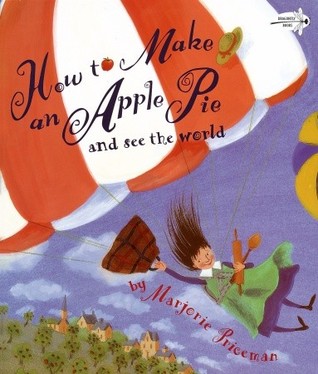
At the end of September, we took our second trip through the book How to Make an Apple Pie and see the world by Marjorie Priceman. During my planning time, I was brimming with ideas for this book. We would gather ingredients from all over the surrounding area. We would make butter. We would pick apples. We would grind wheat. We would visit the cows at our friends farm.We spent two weeks on this book, and didn't accomplish anything on my list of big plans other than baking a pie. But this year seems to be my year for learning that not everything has to line up perfectly at exactly the time that I plan. Set out to learn about apples and end up learning about narwhals instead. That's okay. Take a day off to go to the museum with friends. That can be art too. Go on a fun apple picking adventure several weeks after the fact. That can be awesome too.

This year, we are doing our first group class with several other families at our church. We are spending the year studying Apologia's Swimming Creatures of the Fifth Day. We read the chapters and do the journals at home on our own, and then get together every other week to do the experiments together. On Monday, we had our first class introducing ocean animals. Then on Tuesday, serendipity struck, and we got to tag along on one of my husband's work trips to Cape Cod. After his meeting, we discovered an awesome small aquarium nearby (that was also free).
They had lots of amazing fish and other creatures from the Atlantic ocean including a touch tank with crabs and starfish, and two harbor seals that live in a tank outdoors.


The rain cleared up enough to dip our toes in the ocean. Apparently our children have been ocean-deprived up to this point because they ran around yelling, "There's real sand!" and "I hope I don't fall off the continental shelf!" They loved playing in the waves and collecting treasures.


A recent storm had washed up tons of seaweed and dozens of empty horseshoe crab shells.

We also collected a jar of ocean water to bring home for experiments. In the book, she gathers a jar of water and dries it to make salt. We tried this as well as another science experiment for our ocean class, which involved freezing plain water and salt water to see which would freeze first.

This is an excellent book to talk about geography as the character travels around the world to find ingredients for her pie. We got out our big world map and found all the places she visited. We also found all the names of the oceans to go with our science study. Then we went to our pantry to find where our groceries come from. We also learned a bit about apples and their life cycle. To go along with our studies we read, One Green Apple by Eve Bunting, Bring me Some Apples and I'll Make You a Pie: A Story about Edna Lewis by Robbin Gourley, The Apple Doll by Elisa Klevin, and How do Apples Grow by Betsy Maestro.

We didn't get to go apple picking during the week, but we did visit our local orchard. We chose three different kinds of apples: Gala, Senshu, and Cortland for a taste test. I can never leave the farm store without their discounted "misfit donuts." We always feel like we should give a home to those tiny, misshapen donuts. 

The next day we had an apple-inspired poetry tea. We made little bags of spices to add to our teacups for mulled cider. We read poems about apple trees by local poets Robert Frost and William Cullen Bryant. For our apple taste test, we used a new resource we love: Mystery Science. You can sign up for a free year of science lessons. In each lesson, students solve a mystery by watching a video, discussing the questions, and doing an experiment. We used the lesson: Why are some apples red and some green? The experiment was an apple taste test. I printed out the experiment forms they included and we tasted all our apples and logged our results. The kid loved the lesson and learned all about selection in growing fruits and vegetables.

I decided to do a special lesson with my kindergartener and preschooler. We made apple pie playdough and read The Apple Pie Tree by Zoe Hall, Apple Pie ABC by Allison Murray and The Apple Pie that Papa Baked by Lauren Thompson. They loved it.
The older kids weren't as happy, but they did go off and make a tiny pie from clay and throw a Fall party for all their Calico Critters. Then the younger kids decided they would share the playdoough with their older siblings while we read aloud from Clara Lee and the Apple Pie Dream by Jenny Han, a chapter book about a young Korean-American girl who wants to win the Little Miss Apple Pie pageant, but others question whether she is really as American as apple pie.

My first year I was heavily into Pinterest, but now I rarely go on because it just inspires me to overplan. Even at the beginning of this year, I was printing out way too many worksheets and other activities for the week. One thing I do, though, is take a glance at all the resources I've collected over the years for appropriate activities. A few years ago, Scholastic Teacher Express was offering $1 sales on many of their ebooks, and I picked up a fun one called Math Picture Pages. I found a fun sheet called Autumn Harvest market. It included a fun sheet to color, then you count up the objects in the sheet to make math problems. My older kids did the math worksheets on their level. The little ones did some cut and paste books from the Five in a Row Fold n Learn. This one was an Apple Subtraction book using objects from the book. I also picked up two books from the math section at the library: What Happens at the Orchard by  Amelia Letts and Working at the Farmer's Market by Barbara M. Linde.

One reason I don't use Pinterest as much is that I find that if I leave a little unplanned time in our day, my kids come up with great activities on their own. In this case, my oldest daughter decided to set up a pretend Farmer's Market. She decided to sell kombucha at her market "made from a local SCOBY!." She was also selling potatoes and Trixie was selling apples and zucchini. I gathered up some change and we had some added math fun pricing items and making change.


We finished up our two weeks by baking a pie! This time the kids did almost all of the work of measuring, peeling, and slicing. I only helped a little with the rolling.

Our pie was ready to go in the oven!

The finished product!

As we tried the first bites of our pie, Ella said, "This shouldn't be a book we only do every four years! We should do this book every year. Next year, we can grind wheat and cinnamon and pick apples!" So I guess this may turn into an annual event.

Then what do you know? A couple weeks later, to celebrate my husband's birthday, we went apple picking at the most beautiful mountain-top orchard. We came home and made him another pie for his birthday!
 

Saturday, September 24, 2016

Five in a Row Flashback: How to Make an Apple Pie and See the World

This week we started rowing How to Make an Apple Pie and See the World by Marjorie Priceman. This was the first book we ever rowed with Five in a Row when Ella was in kindergarten. She was five, and my other kids were three, 19 months, and 3 months. She was so excited to rerow this book as a fourth grader. My younger kids don't remember much from the book, so for them it will be like the first time. I thought it would be fun to do Then and Now posts so you can see the differences between rowing for the first time and rowing with an experienced teacher and student. This is the original text from my old blog and I've added my modern commentary in parentheses. Next week, I'll post what we did on our second go around.
We read "How to Make an Apple Pie and See the World" by Marjorie Price. In the book a girl goes around the world to find ingredients to make an apple pie. The girls loved these passport and tickets from Living Life Intentionally and mapping out all the journey to different countries on the map. We tried making some maps and flags from this free lapbook on Homeschool Share, but it was a bit much for us.
(I like many new homeschoolers was dazzled by all the free printables and cool activities that I found on pinterest and blogs. This was my first and only foray into lapbooks for a very long time. When I say "a bit much for us." I meant that I printed out way too many tiny books that I had to cut out and point to the countries for them to color. Also let me remind you that my kids were 5, 3, 1 and 3 months old. Ironically enough, my current 5 and 4 year-olds adore cut and paste and would happily make tiny books for days. If something like lapbooks don't work for your child, or your energy level as a teacher, feel free to scrap it and find something that does work like lots of play, for example.)
They also really liked making a paper bag village from free printables in the lapbook from Homeschool Share. We also made paper bag apple trees and set up a Fall Village for the girls to play with. I added in some around the world figurines I had ordered from Oriental Trading.
(This was more fun, though I'm sure I still did a lot of cutting and pasting. Those apple trees were pure pinterest and I'm sure way above my kids heads!)

We also did a science experiment with evaporating salt from salt water.
(I don't remember doing this at all, though I'm sure we did.)

I made this apple pie sensory bin inspired by Delightful Learning. It has wheat berries in it for scooping, and lots of apple pie ingredients from our play food. It's fun to see them integrating all the stuff they're learning when they're playing.
  
(During my first year, I realized that if I was going to do any learning while my toddler was awake, it had to be something she would enjoy! Look at that gleeful destructive grin. I made the rookie homeschool mistake of trying to set up a classroom in our house. I labored over finding the perfect rug and mourned that the ABC rug sold out and I had to buy the animal rug. I hung one of those calendar charts on the wall with little pockets for numbers. I had one of those rainbow bins for construction paper. Guess what my one-year-old's favorite game was? Ripping out the calendar cards and emptying every drawer of construction paper. I wised up in our second year and moved us downstairs closer to the toys and snacks. We didn't learn many months of the year, but my daughter is still reviewing those in fourth grade so I guess we're okay. For those of you who homeschool with babies, don't feel bad about what you can't do. Read books and play! It will get easier in a few years. Also sensory bins are fun if you have the energy to gather all the supplies and clean up afterward. But you know what else is a great sensory experience? Letting your kids play in a sandbox outside or run in the grass.. Letting them help you bake occasionally or giving them some yogurt in a high chair and letting them feed themselves. Simple is good.)
 

We also made apple pie play dough from this recipe. It has cinnamon, nutmeg, and cloves and it smelled lovely!


We also had a special guest teacher, Julia Child. We watched an episode on apple desserts. She made La Tarte Tatin. We learned a really important lesson from Julia. When she tried to unmold her tarte from the skillet, it totally flopped. She said, "It doesn't matter if you make mistakes when cooking, you can always fix your mistakes." She sprinkled some powdered sugar on top and displayed her flawed tarte tatin right along with the perfect one she had made earlier.  Ella was totally engrossed. She noticed all the things Julia did differently from our baking. I loved her commentary. "Did Julia just brush her flour in the floor?!" "She's making an upside-down pie?" At the end, they showed a film of Julia shopping at a French market. I had pointed out to Ella that Julia is really tall. She said, "Julia is really tall. She's taller than anyone in France!" As soon as it was finished, she said "Another!!" Seems like she has her Daddy's love for Julia!
  
We finished up our "How to Make an Apple Pie and See the World" week by making a pie, of course! I've never made a pie before with a regular pie crust so it was a bit of an adventure with a bit of rerolling and a lot of patching. But it did actually turn into a pie. I thought we would use this little apple cookie cutter to cut the vents in the top, but somehow we ended up with two apple-shaped holes and one elephant-shaped hole. But the girls did have fun! And we learned lots of math and geography while cooking.
(One of the best parts of homeschooling is when you can learn something right along with your children. I got to learn how to make a pie! When you are interested in learning something, it's so inspiring to your kids. There's nothing like homeschooling to make you into a lifelong learner.)

Saturday, September 3, 2016

Five in a Row: Gramma's Walk

Occasionally you will come across an idea that transforms your thinking about how you educate your children. For me, that was the moment I realized that schooling didn't have to happen on the same schedule as public schools, and it didn't have to look the same in every season. Even my homeschooler friends look at me a little skeptically when I say we're back to school in July, but to me it means we can stay inside in the A/C when it's too hot and get ahead on our schooling, so when's it beautiful in Fall, we have time to play! 

A few years ago, I read this excellent post from Jamie Martin at Simple Homeschool: The Case for a Seasonal Education.  It made so much sense to me that the outdoor months are perfect for nature study, while the winter months are perfect for reading aloud by the fire. Spring is perfect for gardening, while Fall is a perfect for time for jumping into new subjects with energy.

Later, I learned about the idea of Tidal Homeschooling from Melissa Wiley, and I loved her idea that there are tides to homeschooling. During high tide, Mom is captaining the boat and using curricula and charting a course and during low tide, you might follow more student-led approaches. She describes it well here: What is Tidal Homeschooling? 

So after a very tough summer, August has been all about low-tide homeschooling and seasonal fun. Appropriately, we went on a road-trip to our favorite seashell beach. We discovered this beach a few years ago on a quest to find the closest Rita's water ice stand. It happened to be in West Haven, CT, and across the street was this small beach that no one seemed to use for swimming or anything really. As a result, there were thousands of shells. You could literally scoop them up with a shovel if you wanted to.

We limited ourselves to one bucket this year.

Most people see seashells as beautiful, interesting things. Teacher moms see them as math and science manipulatives.
 
So we sorted and counted all of our shells, which was great for all ages.We tried to identify them. (Well, that was mostly me, but I was interested, for sure.) I printed out this gorgeous free coloring sheet from Jan Brett to compare to our shells. We had some that matched including: jingle shells, periwinkles, boat shells, quahog, and knobbed whelk.

Then my nine-year-old and I graphed our results. We made our graph using Microsoft Word. We went to the Insert Graph function and explored the different kinds of graphs and settled on a bar graph. When we selected our graph, a spreadsheet popped up and we inserted our information. We collected the most Jingle Shells (75) and the least crab shells (1) though our crab did have a lot of legs.

 
We read Gramma's Walk by Anna Grossnickle Hines. This is a lovely Five in a Row book that I have had trouble tracking down until this year. Recently Purple House Press reprinted it, and I am so grateful for the work they do to reprint Five in a Row books. It's a very gentle story about a boy and his grandmother who is wheel-chair bound taking an imaginary walk on the seashore. My daughter asked if we could take an imaginary journey too. My son decided we should walk through the jungle. So we closed our eyes and took turns taking a walk through the jungle and talking about what we saw, smelled, and heard.

My kids also loved the language arts lesson about the ribbon roll plot. Basically the story unrolls like a ribbon, they see a lighthouse, build a sandcastle, find shells, see an otter, etc. and then they walk back past all of these things. The plot is set up much like the story We're Going on a Bear Hunt. So we made a long ribbon of paper and drew pictures of each object they passed and then rolled the ribbon back up as we walked by, saying goodbye to each object. It was a great demonstration of this style of plot.

The kids were so inspired that they decided to make ribbon roll art as well.
 
Mabel, of course, picked her favorite theme: pigs. She drew out the life-cycle of a pig. Ella made hers into a puppet theater and wrapped the moveable background around the back of a chair and made little sea life puppets to tell the story.

The kids were also inspired to make a craft from a craft book from the library. They made miniature hermit crab aquariums for dolls. A few months ago, I taught the older girls how to insert clip-art in Microsoft word. There is a searchable database of clip-art inside Microsoft Word, and you can find so many pictures. It seems much safer than google images. They have been writing stories and books of facts and inserting clip-art to go with it. Originally, they were going to make a hermit crab out of a shell, but we didn't have all of the right materials, so they printed one out instead and laminated and added sandpaper, and blue and green paper for food and water. We used a plastic apple box to cut out the aquariums.
 
We're excited that we're going to be able to join some friends from our church in a science class on underwater creatures this year, so this book was a lovely introduction. 

Monday, August 22, 2016

Adventures with Beatrix Potter (on the occasion of her 150th birthday)


Some years you get a month into homeschooling and realize you need a reset button. Sometimes it's not even homeschooling's fault. I had gone into a year with high stress, no rest, mixed with sickness, disappointment and grieving. Now here I was staring down two weeks of work travel on my husband's schedule and trying not to panic. But then I realized that we had the car everyday (rare in our 1-car family) so I decided to reclaim our summer, to reclaim our love of learning, and go on some adventures.

About that time I learned that it was the anniversary of Beatrix Potter's birthday, and that there was a new exhibit of her unpublished drawings at the Eric Carle Museum of Picture Book Art. The exhibits have been so good at the Eric Carle Museum this Fall! I feel so blessed to live so close by. It's been such a wonderful addition for our homeschool.

Beatrix Potter has been a hero of mine ever since I saw the movie Miss Potter about six years ago. Since then I've read several biographies of her life (and we also, maybe,  named our daughter Beatrix). The things I most admire about Beatrix are her love of learning, imagination, and her value for preserving old things.

She spent her childhood in an upper-class Victorian home where she rarely saw her parents and was very isolated from the world. Her butler is the one who first started sneaking pets up into her nursery to keep her company, beginning with a mouse named Hunca Munca from the kitchen. Soon Beatrix and her brother Bertram had a menagerie of mice, rabbits, bats, hedgehogs, snails, and an owl. Beatrix who was left to her own devices most of the time loved to draw. She drew all of her pets in great detail. She lived for her summers when her family would spend time in Scotland or the Lake District in England. She could explore nature and draw. As she grew older, she became more scientific in her interests. A local minister in the Lake District encouraged her to start collecting mushrooms and she collected and painted so many that she was able to write a scientific thesis about mushrooms. She sent her paper into a scientific society, but it was rejected because she was a woman.She never gave up, and instead turned her art toward a dream of making children's books. Despite her parents' lack of support, she became very successful.

The other thing I found surprising and wonderful about Beatrix Potter is her interest in farming and land preservation. After  her fiance died, she bought her own farm in the Lake District in England. As the area was threatened by development, she bought abandoned farms all around her property, with an eye to keep them as working farms. When she died, she left over 4000 acres of English farmland to the National Trust to be preserved. She also, in her later years, became a champion sheep-breeder, raising a particular heritage breed of sheep that live on the fells in the Lake District and whose wool make the tweed fabrics she loved to wear in her later years.

Here's how we spent two weeks soaking up all things Beatrix Potter (and ditching our math and reading lessons for adventures.)

We began by reading The Tale of Peter Rabbit and a picture book biography called Beatrix Potter by Alexandra Wallner, and going on a nature walk in a local park. We started with a river scavenger hunt. My girls remembered this from our study of The Raft and wanted to do it again. Then we went on a hike and  looked for mushrooms. We drew some mushrooms in our nature journals. Then a few days later, we saw some mushrooms that Beatrix Potter drew. We were blown away by the detail.


 We also had a Peter-Rabbit-inspired Poetry Teatime. We made currant scones and had honey-vanilla chamomile tea with fresh mint from our garden. We read Potter's two books of nursery rhymes: Cecily Parsley's Nursery Rhymes and Applely Dapply's Nursery Rhymes and read all of our favorites from our Complete Peter Rabbit Library. We are a little obsessed with The Great British Baking Show, so we also had to watch the Victorian episode (which included making a Victorian game pie).

We colored birthday cards and went to see her art in the reading library at the Eric Carle museum. I do apologize to the people trying to listen to story-time, while my kids were running excitedly between the pictures. "Look, mom, it's her rabbits. Look, it's Mrs. Tiggy Winkle. It's Two Rabbits Eating a Turnip!" My soon is obsessed with turnips. I can't even begin to explain it.


Then we had to do some watercolors of our own...

The Rabbit Family by Mabel (7)
   
"Peter and Farmer McGreggie" by Beatrix (5)


In the day and a half that Brent was home, he managed a little Dad-schooling. He taught the kids how to plant houseplants from cuttings. It was raining that day, but we've had so little rain this summer, the kids happily splashed around filled up their pots in the rain. They decided to plant rose-scented geraniums, Christmas cactus, and a rubber tree from other houseplants we have at home.
  
By the end of my two weeks living as an extraverted homeschooler, I was so tired. So we watched the movie Miss Potter. I thought it would be too old for them and a little too sad, but we ended up watching the whole thing. My oldest especially loved it. Later she decided to make a diorama of Beatrix Potter's room using her toys. Notice Norman Warne in the back and the mushrooms on the shelf. 


She didn't have all the right parts, so she found clipart from Microsoft Word and I helped her shrink it down and she colored and cut out the brushes and paints. She also took the pictures of her set-up. I love how it turned out!


If you'd to learn more about Beatrix Potter, I recommend these biographies:
Picture Book: Beatrix Potter by Alexandra Wallner
Short Chapter Book: The Country Artist: A Story about Beatrix Potter by David R. Collins
Middle Grade Biography: Nothing is Impossible: The Story of Beatrix Potter by Dorothy Aldis
Adult: Beatrix Potter: Artist, Storyteller, Countrywoman by Judy Taylor
Film: Miss Potter 
Also if you are a total Beatrix Potter geek and you like cozy mysteries and thinking of her as a detective, I really enjoyed The Cottage Tales of Beatrix Potter series by Susan Wittig Albert.