Pages

Showing posts with label Robert McCloskey. Show all posts

Thursday, August 11, 2016

Make Way for Ducklings

 For our second week of school, we spent the week with Make Way for Ducklings by Robert McCloskey, which is in Volume 2 of the Five in a Row curriculum.

Our family has been dreaming of buying a little mini-farm in the country. We've spent the last six months renovating our house and decluttering and trying to sell our house. I even convinced the kids to sell some of their excess toys at a tag sale and start saving for their livestock fund.

For now our dream  of moving seems to be on hold, but the kids still love to imagine all the livestock they can have in our dream house. After their dad played them a homesteading podcast about keeping ducks, ducks replaced sheep on their list. So they were eager to learn more about ducks.
 
I am still learning lessons in these first few weeks of homeschool. Every year, I print out way too many printables at the beginning of the year. My kids actually love worksheets. In fact, they will beg me to print out worksheets for them just for fun. However, I often fall into the trap of thinking, "if I print out that mini-book about animal parenting, that will help us learn about ducks," when really what it turns into is "we will have something to put into our binder to show we learned something." Well, this week reminded me how real learning happens:: by interacting with nature, reading great books, and integrating knowledge into play.  

We started out our week with a lesson in geography. I found a map of Boston and we traced the route Mr. and Mrs. Mallard too from the Boston Public Gardens to the island in the Charles River and back. McCloskey was an art student in Boston, so all of the pictures are based on real places he would walk by on his way to art school. We are planning a field trip to the Boston Public Gardens to ride the swan boats soon.

On our second day we read several non-fiction books about ducks and nests and played a mother and baby animal matching game with my younger two. I knew I had printed this out last year and searched my whole house, then as soon as I pulled the cards out, my daughter goes to the cabinet and pulled out the old laminated cards. Now we have two sets! I did print out the cards 2 pages to a sheet the second time, which made them the size of regular Memory cards.  I had planned to do a mini-lapbook page, but after the kids declared they were going to gather up all their toy ducks and play duck farmers, I left them to it and recycled the pages. 

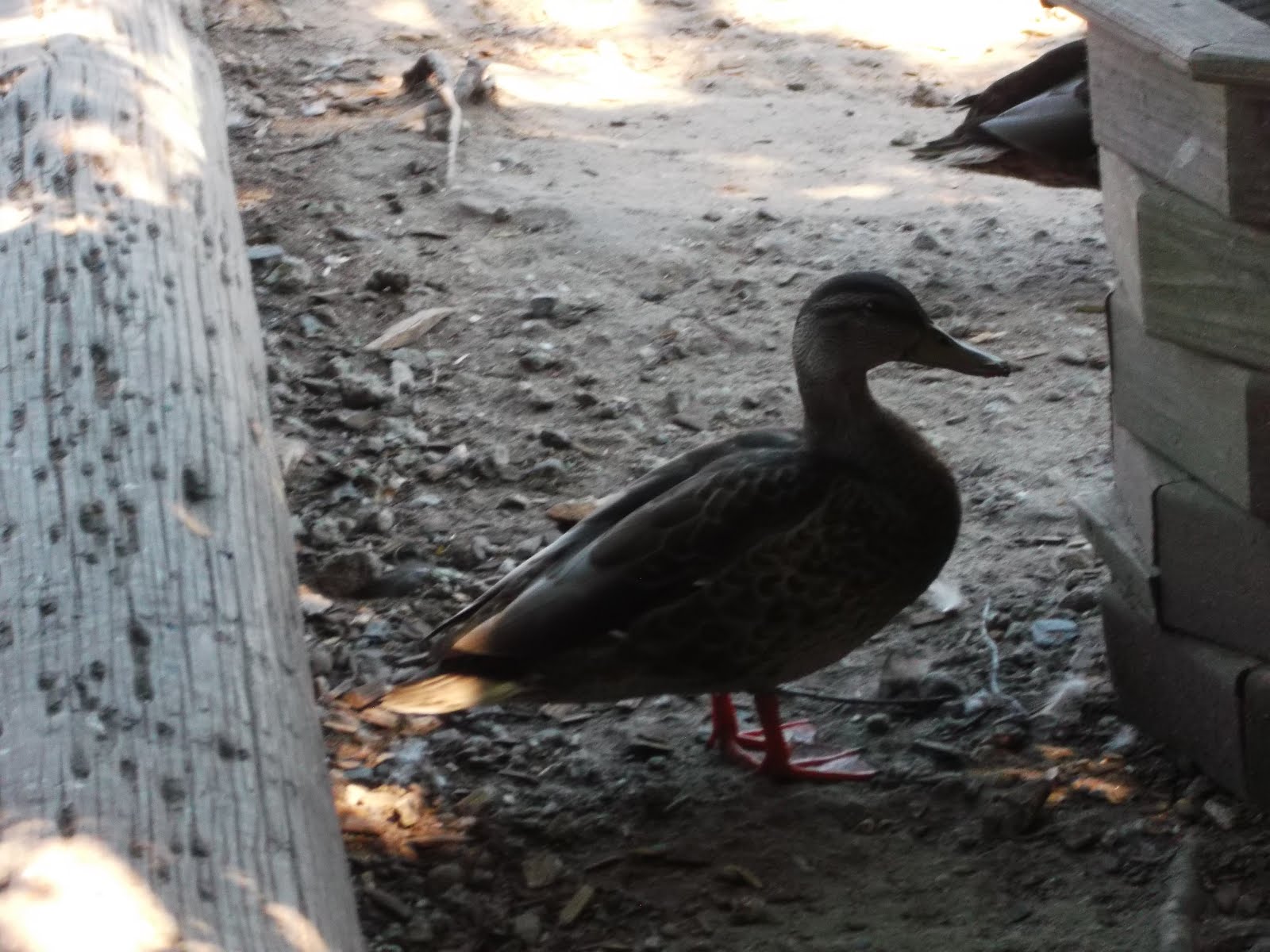
My oldest daughter remembered that she had seen ducklings at a local petting farm when she was on a Daddy-date, so we decided we would go there and draw and observe ducks the next day. She even printed us up some official nametags and laminated them so it would be an official field trip.
The ducklings had grown up some, but there were lots of mallards to observe. Gary Schmidt has some wonderful stories about the making of Make Way for Ducklings in his biography Robert McCloskey. Did you know that Robert McCloskey spent over two years on the art for Make Way for Ducklings? He studied stuffed ducks at the Museum of Natural History. He visited an ornithologist to learn about the shapes of their skulls. Eventually, he decided to buy live ducklings for his models. He carried them home on the subway and kept them in his studio in New York. His roommate Marc Simont drew the bad lot of having to share a bedroom with the ducklings. The little ducklings caused quite a ruckus in the studio. Gary D. Schmidt quoted McCloskey as saying "I spent the next weeks on my hands and knees, armed with a box of Kleenex and a sketch book, following ducks around the studio and observing them in the bath tub." They sloshed water from the tub, leading to complains from the apartment downstairs." The ducklings were always too fast for McCloskey, so"The solution for their rapid movement was an unorthodox one. "The only thing that worked was red wine. They loved it and went into slow motion right away." When he was done, McCloskey wandered all over New York trying to give the ducks away to a butcher and came home defeated with a box of loud, hungry ducks.  They eventually were taken in by a friend in the country.

My nine-year-old took her camera along and took some amazing portraits of the ducks. 

They were also made great models for some scientific drawings and notations such as differences in duck bills in different breeds of ducks.
We also got to practice drawing from live models.
My four-year-old was not interested in drawing, but he did love finding out if the ducks like peanuts. They do! When a mower disturbed some mallards resting in the shade, two dozen ducks jumped into the water and swam across. He shouted, "It's the real Make Way for Ducklings!" 

Of course, we had to visit the pigs, llamas, mini-donkeys, goats, chickens, and peacocks at the farm too, and go home with a half-gallon of mint-cookie ice cream. A great field trip, all told.

On Thursday, we learned about rhyming words and made a word family of ducks in a pond. I printed out some duck outlines using the clipart on Microsoft word and the kids filled them in with words that rhymed with -ack or -uck. We managed not to get into any trouble with that one. We also learned the spelling rule for words ending with -ck. I'm trying to stick spelling rules in wherever we can these days! We had our weekly poetry tea time with ice tea and ice cream from the day before.

Then on Friday, we watched an excellent National Geographic film we found at the library called "Duckumentary."

When I write about our "rows" with Five in a Row, I never feel like I get to the heart of it all, because really "heart" is what is at the core of this curriculum. The books were carefully chosen for their heart, and the Five in a Row manuals have taught me how to read books with my kids in a way that is about relationships as much as learning.  The little conversations you have with your kids about how a parent makes a good home for a child (even if they are ducks) or noticing little details in the drawings like the expression on Mrs. Mallard's face when she is leading the ducklings down the street, or the way your kid will pop up with some little bit of information days later about mallard ducks or nests or art, those are the priceless parts of our weeks that I can't quite capture here.

Saturday, August 6, 2016

Why We Need Robert McCloskey's Books in a World at War


While I am sure that I probably read Robert McCloskey's classic books like Make Way for Ducklings and Blueberries for Sal when I was a child, I didn't really discover Robert McCloskey until my mom recommended his book One Morning in Maine when I was a new mother. I found a beautiful copy at a thrift store on vacation, and fell in love with the book. I have only visited Maine a few times on vacation, but there was something warm and friendly and rooted in place about the book that drew me in. It's a long book by today's standards: 63 pages to the typical 32 and, yet, I could read it over and over again because of all the unique details about life in Maine: the loons and seagulls, and little Sal losing her tooth while digging for clams with her father. Then there is the adventure of Sal and her little sister Jane going on the boat with their Dad to Buck's Harbor and telling the exciting news of the lost tooth to all the town regulars, getting a free ice cream cone, and being excited about having clam chowder for lunch. There was a simple joy that exuded from the pages.

Later I found out that McCloskey based the book on his own life. After returning from World War II, he bought an island in Maine where his family lived six months of the year. The daughters in the book are based on his real daughters, Sarah and Jane, and his wife posed for the drawings in Blueberries for Sal and One Morning in Maine. You also might recognize this guy...


I recently read a biography of Robert McCloskey by Gary D. Schmidt (yes, the same Gary D. Schmidt that is the Newbury-award-winning author of The Wednesday Wars). In his conclusion to the book, Schmidt really captured why McCloskey's books were so popular and needed when they came out in the mid-Twentieth-century, but also why we need them now...
 "McCloskey's vision of children's literature is the more remarkable considering that the two decades of his career in children's literature spanned the most turbulent time of the twentieth century...In the midst of this dreadful world--in the midst of folly and violence and threatened destruction--appeared a series of books that celebrated childhood, family, friendship, the natural world--in short, life itself. If this seems an anomaly, it might be noted that McCloskey's vision in his children's books is one of absolute affirmation of the permanence and beauty and significance of the world. "You snap off the light and row toward the dock as the stars are gazing down, their reflections gazing up, " he writes in Time of Wonder. "In the quiet of the night one hundred pairs of eyes are watching you, while one pair of eyes is watching over all."(28). The numinous quality of this affirmation denies the despair that might be caused by a world at war.
...The worlds of the Midwest, Boston, and the Maine coast are benevolent, full of wonder, physically splendid. They are homes with all that that word connotes; warmth and security, family relationships, innocent joys, the freedom for children to grow and relish the unalloyed splendors and mysteries of the world that lives close about them. McCloskey's strength was his ability to deny the primacy of a world that chose to war with itself. "Yes, that's true," he might say, "but come see this. It is ever so much more important." And the reader is drawn from sadness to joy, from despair to hope, from denial to affirmation."
 In a world wracked by violence, terrorism, and fear-mongering politicians, what can we as parents do to maintain hope and pass it along to our children? S. D. Smith, the author of The Green Ember, had an excellent article at BreakPoint.org called "Stories are Light: Ranting is Arson." I recommend reading the entire article, but to give you a taste, he advised. "By the time the election comes, it’s too late. It’s been too late for a long time. Our hearts were already won over by the stories we loved as children, the tales that shaped us as profoundly as anything else in life. Likely more." and "What is one thing you can do today to “save the world?” Read your children a good story. It may seem unsatisfying when compared with gearing up to blast the internet in a fever of pyromaniacal rage. But it will do a lot more good."


Robert McCloskey's books are a wonderful place to start. Pick blueberries with Sal, get an ice cream cone in Buck's Harbor with little Jane, learn to play a harmonica with Lentil, find a home in the Boston Public Gardens with Mr. and Mrs. Mallard, and make way too many donuts with Homer Price. In a time that feels cold and hopeless, we need books that help us dwell in a world of "warmth and security, family relationships, innocent joys, the freedom for children to grow and relish the unalloyed splendors and mysteries of the world that lives close about them."

 
If you like this post, you may also enjoy more Robert McCloskey goodness here: Why Our Children Need Art (and Picture Books)

Wednesday, June 25, 2014

Why Our Kids Need Art (and Picture Books)

"With everyone clamoring for more scientists, I should like to clamor for more artists and designers. I should like to clamor for the teaching of drawing and design to every child, right along with reading and writing. I think it is most important for everyone really to see and evaluate pictures and really to see and evaluate his surroundings." This quote by Robert McCloskey, the Caldecott award-winning author of Blueberries for Sal, Time of Wonder, and my personal favorite One Morning in Maine, has forever changed the way I think about teaching children art. 

I have always loved making art, but I had never connected learning to draw and paint and sculpt with learning to see the world. Being able to look closely at a picture and recognize what makes that picture a thing of beauty or jarring and ugly is essential for being able to make great art, but it's necessary on a bigger scope as well. Children live in a world where there is wonder and beauty, but there is also a lot of ugliness, both in the physical landscape and in people's souls. Children will become adults who have to navigate this and either bring more beauty into the world or more ugliness. If a child has climbed a mountain and seen the grace of the layered ridges that seem to go on forever, how can they see a strip mine and not see the inherent wrongness of it?
Mountains inspired by The Rag Coat By Lauren Mills
"Citing examples of deliberately misleading print advertising and television images and of the kind of runaway land development that was blighting larger and larger swaths of the American landscape, McCloskey argued that at a time when such excesses were commonplace it was essential for people to know how critically to evaluate every aspect of their visual environment. There was no better way, he concluded, to accomplish this vital goal than by teaching people how to draw from an early age." Minders of Make-Believe: Idealists, Entrepreneurs, and the Shaping of American Children's Literature by Leonard Marcus

After reading this I began to see art not as dabbling in paint and clay, but as a process of teaching my children to look closely at the world, but at the same time to see the bigger picture, the whole; to slow down our looking and truly see what makes a picture beautiful. 

I have not adopted any fancy art curriculum. I put all that money into quality art supplies instead. The art we looked at was easy to find. It was all in picture books. Children are lucky to be surrounded by so much amazing art created by truly talented artists. This was really brought home to me on a recent visit to the library at The Eric Carle Museum of Picture Book Art. We shouldn't be too quick to put picture books away and move to chapter books. When else in life, will kids have access to so much art? 

pastel drawing inspired by Night of the Moonjellies by Mark Shasha
The curriculum we use Five in a Row is based on classic, wonderful picture books like McCloskey's Make Way for Ducklings. The author Jane Claire Lambert put a lot of attention into developing the art lessons and this past year, I've had a new vision for our art days. I try to do them at the beginning of the week instead of letting them slide at the end. We go through the picture book of the week looking closely at the pictures, noticing the medium the artist used, the colors, the textures, the details, thinking about how these things change the mood of the picture and what the story is trying to stay. Then we get out whatever art materials the illustrator used and we make art ourselves. Sometimes we make lovely pictures and sometimes it is more about the process. Already, I find the kids looking closer at all their books, noticing that they are painted with watercolors or that the warm colors make the pictures seem happy and bright.
collage inspired by Eric Carle's book The Tiny Seed
I recently found a free ebook of an old book Wings and the Child or, the  Building of Magic Cities by British children's book author E. Nesbit. She had more to say about the importance of surrounding our kids with beauty and teaching them to resist uglification in our world.

"Therefore I would plead with all those who have to do with children to resist and to denounce uglification wherever they may meet with it, and to remember that there is knowledge which goes hand in hand with beauty. To show a child beautiful things, and to answer as well all the questions he will ask about them, to charm and thrill his imagination with pictures and statues and models of the wonders of the world, to familiarise the child with beauty, so that he knows ugliness when he meets it, and hates it for the outrage it is to the beauty he has known and loved ever since he was very little--this is worth doing. If we would make beauty the dear rule of man's life, and ugliness the hated exception, we should make beauty as familiar to the child as the air he breathes, and if we associate knowledge with beauty the child will love them both."